How to Check the Metadata of a Photo or File (iPhone, Android, Windows and Mac)
Four built-in ways to look inside a picture, what each of them politely omits, and how to read the entire record in one go.
Every device you own can already show you some of what a picture is carrying. None of them shows all of it, and that gap is where people get caught out. Somebody looks at the details panel on their handset, sees nothing alarming, and concludes the file is safe to publish.
This guide walks through the four built-in viewers most readers have access to — Apple's Photos app, the Android details panel, the Windows Properties dialog and Preview on a Mac — and is explicit about what each one renders and what it skips. Then it covers the step that closes the gap, which is reading the file itself rather than a summary of it.
Why bother looking before you share
Three reasons come up repeatedly. The obvious one is confirmation: you cleaned a file and want proof that the coordinates really went away rather than trusting a progress bar. The second is triage — deciding whether a particular picture even needs attention, which saves you from processing an entire album out of vague anxiety.
The third is curiosity, and it is underrated. Most people have never seen the list, and reading it once changes how they treat their own camera roll. The Office of the Privacy Commissioner of Canada makes the point that descriptive records of this kind become far more revealing in bulk than any single entry suggests, and that is much easier to believe after you have examined a few of your own pictures.
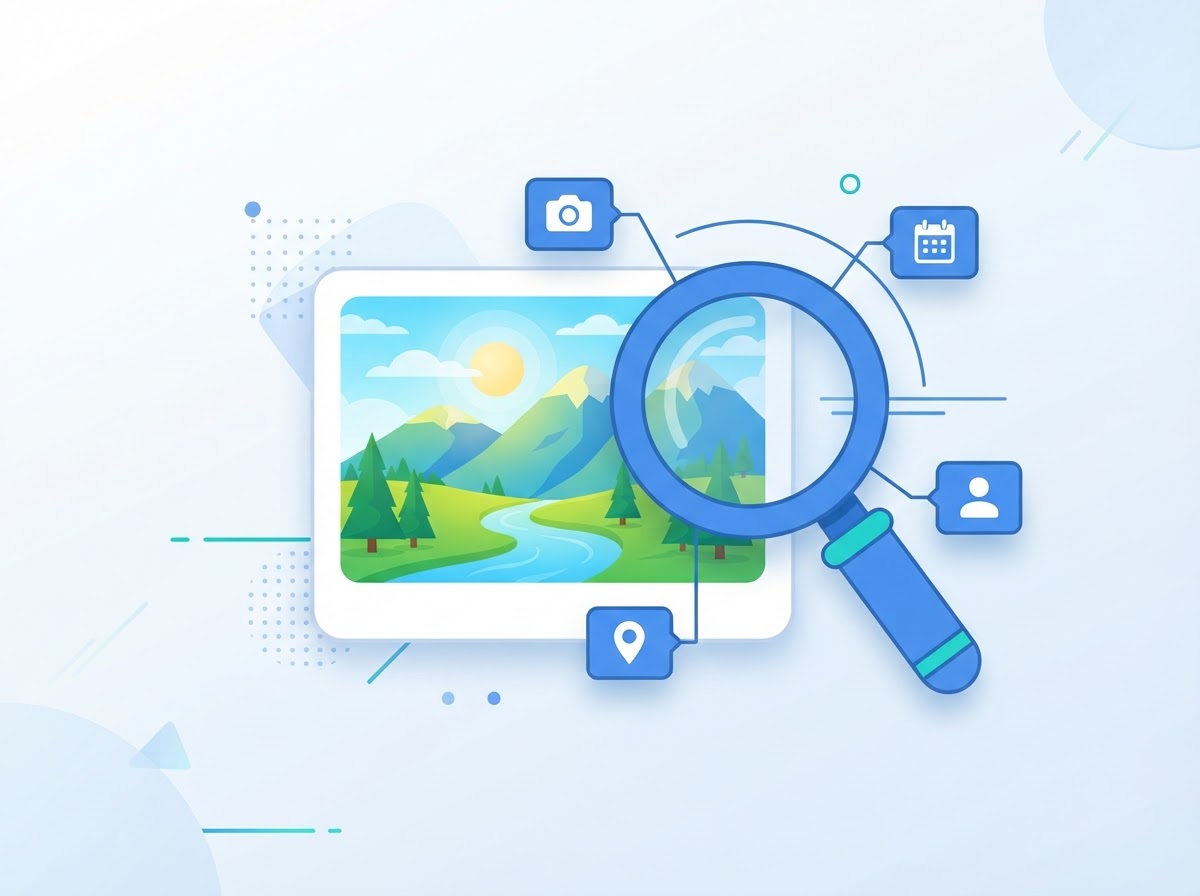
What you are looking for: the hidden record a device attaches to a file — the hardware that produced it, the second it was produced, the coordinates if positioning was switched on, and the names of whatever software has touched it since. None of this appears in the visible image.
iPhone and iPad
Apple exposes this through the Photos app, and it has been pleasantly direct since the information panel became a standard gesture.
- Launch Photos and open the picture you want to examine.
- Swipe upwards on it, or press the circled i button beneath it.
- Read the panel. You should see the day and time, the handset or camera name, the lens description, resolution, file size, and a small map extract whenever positioning data is present.
- Press the map to enlarge it. Apple resolves the coordinates into a place name, which makes the exposure immediately obvious in a way that raw numbers never do.
What it leaves out. Quite a lot. You get no body serial number, no originating software string, no caption or rights entries, and no view of the colour profile. Apple's own guidance on location access covers switching positioning off for the camera, but the panel itself was designed for browsing rather than auditing.
Android
Android has no single answer, because the gallery varies by manufacturer. Two routes cover almost every handset.
Through Google Photos
- Open the picture in Google Photos.
- Swipe upwards, or press the information icon in the toolbar.
- The details sheet lists the day, the file name and size, the resolution, the device name and the main exposure values, plus a map when positioning data exists.
Through the Files app
- Open Files and browse to the picture.
- Press and hold it, then choose File info or Details.
- Expect a shorter list here — usually path, size, format and modification time — with camera entries sometimes absent entirely.
What it leaves out. The same categories Apple omits, plus the inconsistency problem: the identical picture can produce different summaries in two apps on one handset. Google's documentation on location in photos explains how the service treats positioning data, which is worth reading alongside what the panel displays.
Windows
The Properties dialog has carried this information for well over a decade and remains the fastest route on a desktop.
- Right-click the picture in File Explorer.
- Choose Properties, then open the Details tab.
- Scroll the grouped rows: Description, Origin, Image, Camera, Advanced photo and GPS. Latitude and longitude show as numeric values rather than a map.
- Note the link at the foot of the dialog reading Remove Properties and Personal Information. It is a genuine cleaning function, limited to the fields Windows recognises.
What it leaves out. Windows renders what its property handler understands. Packets written by editing suites — the XML-based records and the press-industry caption fields explained in our guide to EXIF, XMP, IPTC and ICC — frequently do not surface at all, so a file can look empty here while still holding a photographer's name.
macOS
Mac users have two options, and the better one is not the obvious one.
Finder's Get Info
Select the picture and press Command-I. You get dimensions, format, size and filesystem dates. Useful, but shallow — this is a file panel, not a photographic one.
Preview's Inspector
- Open the picture in Preview.
- Choose Tools, then Show Inspector (Command-I).
- Select the tab bearing an aperture symbol. Preview separates the record into General, EXIF, GPS, TIFF and sometimes IPTC tabs.
- Work through the tabs individually. The GPS tab carries coordinates, altitude and a direction reading when the camera stored one.
What it leaves out. Less than the others, which makes Preview the strongest of the four. It still presents parsed highlights rather than a raw dump, and it is obviously unavailable to anyone not holding a Mac.
The four compared
| Where | How to reach it | Shows positioning? | Main blind spot |
|---|---|---|---|
| iPhone Photos | Swipe up, or press the information button | Yes, drawn on a map | No serial, software, caption or rights entries |
| Google Photos | Swipe up, or press the information icon | Yes, drawn on a map | Brief summary; varies between apps |
| Windows Properties | Right-click, Properties, Details | Yes, as raw numbers | Ignores packets it cannot parse |
| macOS Preview | Tools, Show Inspector, aperture tab | Yes, on a dedicated tab | Still a curated view, and Mac only |
| Browser-based viewer | Open the page, choose a file | Yes, with a map link | Decodes the privacy-relevant tags, not every obscure one |
Something we noticed while testing
While preparing this article we ran one picture through all four panels and then through our own reader, noting which categories each surfaced. The method was deliberately plain: a single JPEG straight from a handset, opened in turn, with the visible headings written down each time.
The pattern was consistent. Every panel reported the day, the hardware and the coordinates — the three things people check for. Not one of the mobile panels mentioned the embedded preview thumbnail, and only the full reader listed the colour profile. That thumbnail deserves a mention of its own: it is a miniature copy generated at capture, and in some editing workflows it survives a crop unchanged, which means it can still depict the portion you believed you had cut away.
Worth repeating: a summary panel showing nothing worrying is not the same as a file holding nothing worrying. The two statements feel identical and are not.
Reading the whole record at once
When you want certainty rather than a sample, you need something that parses the bytes and prints what it finds. That is precisely what our metadata viewer does, and because it runs inside the page there is no upload step at any point.
- Open the viewer on whichever device holds the file. It behaves the same on a handset as on a laptop.
- Pick the file, or drag it onto the drop zone. Pictures, portable documents and office formats are all accepted.
- Read the grouped report: file facts, positioning, camera and lens, exposure, dates, authorship and software, embedded blocks, and the document properties where they apply.
- Check the summary line at the top, which flags entries that look personal rather than merely technical.
- If something needs to go, follow the link through to the matching cleaner — for pictures that is the image metadata remover.
One caution applies to every online inspector, ours included. If a service parses files on a remote machine then your picture has been transmitted to a stranger's computer in order to answer a question about privacy, which is an odd trade. Verify where the work happens before you upload anything sensitive; our privacy policy sets out what this site does and does not receive.
Making sense of what you see
A long list is intimidating until you know that most of it is harmless. Sort the rows into three mental buckets.
- Identifying. Coordinates, capture timestamps, hardware serial numbers, creator and rights entries. These are the rows that matter, and they are the reason the exercise exists.
- Technical. Aperture, sensitivity, shutter duration, focal length, orientation, colour profile. Genuinely useful to photographers and revealing of nothing about you.
- Descriptive. Captions, keywords, headlines, credit lines. Usually typed by a person, which is exactly why they so often contain a real name or a town.
Our field-by-field breakdown in what is EXIF metadata goes through the camera block tag by tag if you want the detail behind that grouping.
Frequently Asked Questions
How do I check photo metadata on an iPhone?
Open the picture in Photos and swipe upwards, or press the small information button below it. A panel appears with the capture date, the camera and lens, the exposure values and a map if the shot was geotagged. It is a summary, so several stored fields are never displayed there.
Can Android show me the EXIF data of a picture?
Google Photos has a details panel reached by swiping up or tapping the information icon, and most Files apps offer a similar screen. Both present a short summary rather than the complete tag list, and the exact wording changes between manufacturers and software versions.
Where is the metadata in Windows File Explorer?
Right-click the picture, pick Properties and open the Details tab. Windows groups the entries under headings such as Origin, Image and Camera. It renders what its own property handler understands, which means XMP and IPTC blocks written by editing software may not appear at all.
What is the quickest way on a Mac?
Open the picture in Preview, choose Tools and then Show Inspector, and select the tab marked with an aperture symbol. Preview separates general, EXIF, GPS and TIFF data onto their own tabs, which makes it the most thorough of the four built-in viewers.
Why do two viewers report different fields for one picture?
Each program decides for itself which standards to parse and which rows deserve screen space. One may read only the camera block, another may add colour profiles and caption records. Nothing is being hidden deliberately; you are simply seeing different slices of the same file.
Is it safe to inspect a private picture in a web page?
It depends entirely on where the parsing happens. Services that transmit your picture to a remote machine receive a full copy of it. A page that decodes the bytes inside your own browser never transmits anything, which is the design we chose for our own viewer.
Can I inspect PDFs and Office files the same way?
Yes, although the field names differ. A PDF keeps a document information dictionary plus an optional packet of XML, while Office formats store property files inside the archive. Our viewer reports all three families, so one page covers pictures, portable documents and office files.
Does opening a picture change its metadata?
Merely viewing it does not. Saving or exporting it from an editor usually does, because the application writes its own name and fresh timestamps into the new copy. If the original must stay pristine, duplicate it first and experiment on the duplicate.
Conclusion
Inspecting a file is a thirty-second habit that replaces guesswork with evidence. The panels built into your phone and computer are perfectly good for the common question — is there a location attached to this — and they are always available, which counts for a great deal.
Reach for a complete reader when the answer actually matters: before publishing something sensitive, or after cleaning a file and wanting proof the job was done. Look once, decide, then act.
Check what your photo is carrying right now — the file is read on your own device, nothing is uploaded, and the viewer never alters what it opens.
Sources
- Apple Support — Control access to location information on iPhone
- Google Photos Help — Location information in photos
- Microsoft Support — Remove hidden data and personal information
- Library of Congress — Exif, Exchangeable Image File Format
- Office of the Privacy Commissioner of Canada — Metadata and Privacy
Menu wording varies between operating system versions and Android manufacturers; the steps above reflect current releases as of October 2026. External links open in a new tab.